
Ensemble: mixed choir, soprano solo, baritone solo, symphony orchestra – 2.2.2.2-4.3.3.1-3perc-hp-str
Duration: 55’
Year of completion: 2025
Premiere: February 5, 2026. Nóra Tatai (soprano), Csaba Horváth (baritone), Hungarian Radio Symphony Orchestra and Choir, cond.: Gergely Dubóczky. Budapest, Pesti Vigadó.
Note:
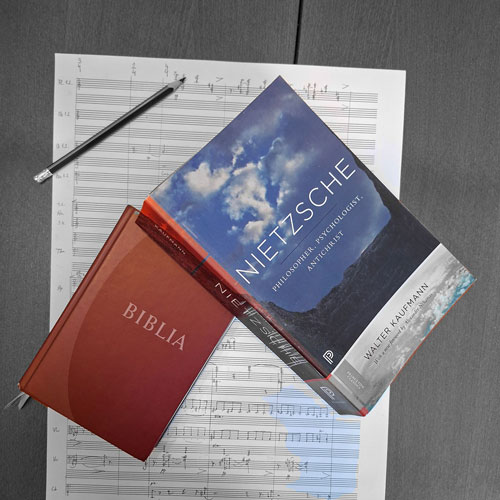
Perhaps we are all Nietzsche’s disciples, even if we are not aware of it. It is enough to think of ideas such as these: we become what we want to become; there is no pre-given inner essence. Or this: there is no above and below, no fixed boundaries. Or this: everyone makes their own laws. Or, for instance: it is not truth that holds power, but power that determines what is truth. The influence of Nietzsche’s thought has been so profound that his books can almost be regarded as “modern sacred texts”. And sacred texts have always been indispensable to artists – even when they did not believe in them.
The conceptual point of departure for the work is Johannes Brahms’s A German Requiem. Brahms, who was raised as a Protestant but later became a free thinker, based the libretto of his oratorio exclusively on biblical texts. At the same time, he created a libretto that gave rise to new, theologically unorthodox meanings. In a certain sense, he created a secular work from sacred texts: rather than focusing on the eternal fate of the deceased, his composition places its emphasis on comforting those who remain. My new oratorio reverses this concept: how can a work imbued with a sacred intensity emerge from secular, philosophical texts?
My work Der Gekreuzigte (The Crucified), based on texts by Friedrich Nietzsche, János Pilinszky and the Bible, can be understood as a contemporary Passion: a reimagining of the tradition of the sacred oratorio from a 21st-century perspective. At the centre of the oratorio’s text stands the famous passage “The Parable of the Madman” from Nietzsche’s The Gay Science, in which the declaration “God is dead” is made. The work does not affirm the truth of this statement, but rather explores its existential consequences. In the course of the piece, I attempt to create a post-religious tableau that explores the painful experience of the loss and absence of transcendence – the tension in which modern humanity is simultaneously moving away from traditional spiritual frameworks while remaining deeply vulnerable to its longing for meaning.
(Balázs Kecskés D.)
Recording
Not publicly available